Challenge 1: The Administrative Gate Bottleneck
Operating a world-class maritime terminal requires meticulous attention to regulatory compliance. Comvex must manage extensive and rigid compliance workflows, including customs declarations, import/export controls, environmental logs, and precise internal weighbridge reporting.
Historically, this mountain of paperwork was tackled entirely at the terminal gatehouses:
● The Manual Drag: Gate guards and dispatchers had to physically inspect cargo notes, verify transport manifests (known locally as the aviz), and manually type carrier data into the terminal’s central ERP.
● The Gate Latency: This sequential human process took an average of $6\text{ minutes}$ per truck. During peak harvest seasons or heavy vessel loading cycles, this latency created massive vehicle queues on public approach roads, severely impacting surrounding infrastructure.
● Reactive Operations: Because the data was only logged after the truck crossed the physical gate, the terminal’s operations team was always reacting post-event, with zero forward-looking visibility into incoming traffic.
Phase 1 Solution: The 'Driver-Operator' Data Model
By deploying the Lares Access Automation App integrated with custom web-based booking forms, Comvex completely flipped the data collection paradigm on its head:
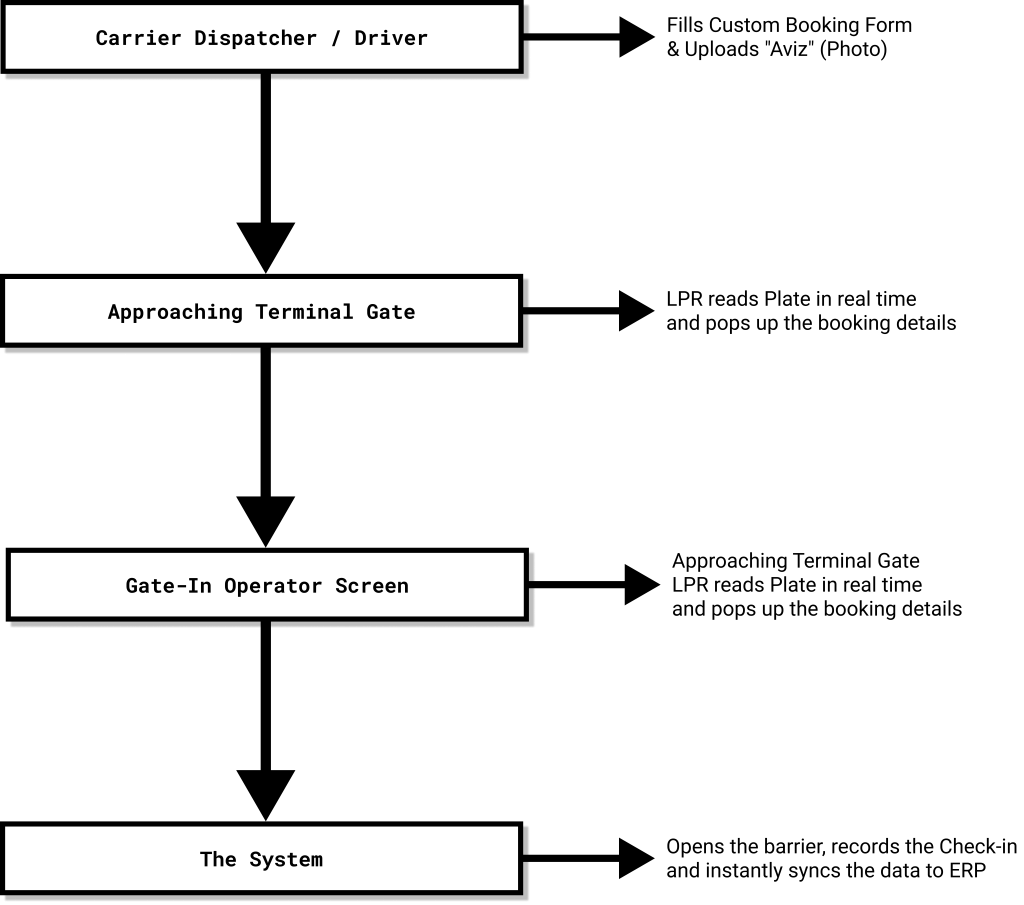
[Carrier Dispatcher / Driver] ──► Fills Custom Booking Form & Uploads 'Aviz' (Photo)
│
▼
[Approaching Terminal Gate] ──► LPR reads Plate in real time and pops up the booking details
│
▼
[Gate-In Operator Screen] ──► Makes the necessary correction (if any) and saves the data
│
▼
[The system] ──► Opens the barrier, records the Check-in and instantly syncs the data to ERP
1. Outsourcing Data Ingestion
Instead of burdening on-site gate staff with manual typing, the responsibility was moved upstream. Carrier dispatchers or drivers must now complete a custom booking form before arrival, uploading a clear photo of their physical transport notice (aviz). In this new flow, the driver effectively becomes the data entry operator.
2. Zero-Friction Gate Check-In
When the truck reaches the terminal perimeter, high-speed License Plate Recognition (LPR) cameras read the license plate instantly. The system queries the active database and automatically displays the pre-filled booking record, the uploaded document, and the validated parameters on the gate operator's screen.
3. Straight-Through ERP Processing
The gate operator’s task is simplified from heavy data entry to rapid visual confirmation. The operator verifies the truck, checks the uploaded aviz against the real document, makes any necessary minor corrections, and clicks approve. The system instantly routes the vehicle inside and automatically synchronizes all transaction parameters into the Comvex ERP.
The Impact
By moving from manual entry to automated on-site validation, physical gate processing times dropped from $6\text{ minutes}$ to under $60\text{ seconds}$ for over $90\%$ of all trucks. The manual workload for gate personnel was drastically reduced, and the primary bottleneck of the receiving timeline was eliminated, shifting Comvex’s operational focus downstream to optimizaing labor cost and the sampling laboratory.

Challenge 2: Uncontrolled Queue Chaos & Static Drag
Before scheduling rules were put in place, trucks arrived at the Comvex terminal completely at random. This erratic flow created severe bottlenecks and idle labor:
● The Congestion Trap: Trucks frequently arrived hours (or even days) before their scheduled window. This premature arrival tied up terminal parking capacity, causing massive backlogs. This was particularly problematic when the terminal’s intake systems were physically configured for a different product type, or when a specific trading partner had priority due to strict vessel loading timelines.
● The Missing Windows: Conversely, when trucks arrived late, they missed critical processing windows. This resulted in idle docks and wasted labor hours for Comvex, or forced carriers to redirect high-value cargo to alternative terminals.
● Transport Inefficiency: Carriers were forced to operate blindly, keeping expensive assets (trucks and drivers) stuck in standstill queues rather than rotating them efficiently to complete multiple trips.
Phase 2 Solution: Dynamic Timeslot Optimization & Active Traffic-Shaping
To resolve this queue chaos, Comvex deployed the advanced capacity-pacing features of the Lares Yard App:
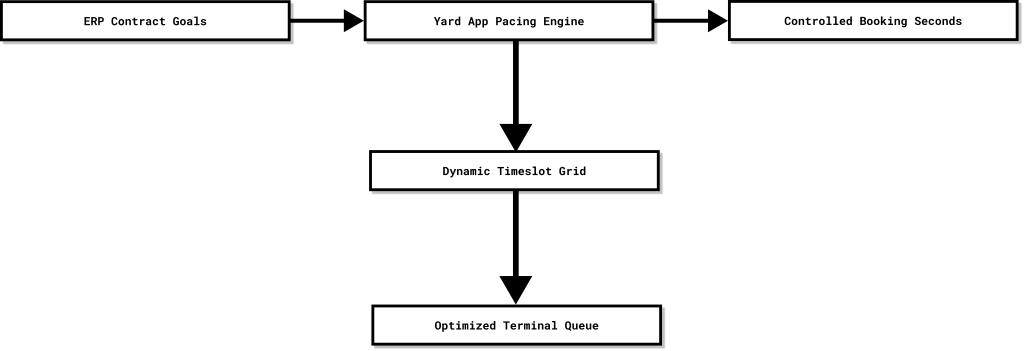
[ERP Contract Goals] ──► [Yard App Pacing Engine] ──► [Controlled Booking Seconds]
│
▼
[Dynamic Timeslot Grid]
│
▼
[Optimized Terminal Queue]
1. Dual-Layer Booking Rules
As the first step in the workflow, Comvex configures precise rules governing which constraints apply to specific time intervals and specific docks. These rules—established either manually through the user interface or automatically via our API—allow Comvex to dictate the exact flow of grain and mineral traffic based on real-time operational limits. The system categorizes these controls using two distinct rule types:
● Permissions (Routing Rules): Used to generate explicit routing conditions. SIDs (Shipment IDs) that do not meet these permission conditions are completely restricted from accessing specific docks and timeslots (the system dynamically returns zero available options for these parameters).
● Limitations (Capacity Rules): Used to impose hard operational limits on logistic movements (for example, capping a partner at a maximum of $50\text{ trucks}$ per day). Once this threshold is reached, no timeslots will be available that day for any subsequent SIDs matching those limitation conditions.
2. Real-Time ERP Synchronization
Because timeslot availability must dynamically shift in sync with the actual needed cargo quantity, the system relies on an accurate, real-time feedback loop. Not every registered truck will ultimately be unloaded, and even when they are, the exact quantity is only finalized at the weighbridge after check-in, often deviating from the initial paperwork. To maintain perfect accuracy, the Yard App periodically synchronizes these parameters directly from the Comvex ERP—either automatically through API integration or via rapid manual updates in the user interface—ensuring scheduling matches real inventory needs.
3. Proactive Late Arrival Management
To protect dock productivity from transit delays, Comvex deployed our automated late arrival safeguards:
● Pre-Arrival Verification: If an approaching truck is not detected within the port perimeter, the system automatically sends an SMS to the driver exactly one hour before their scheduled timeslot, prompting them to confirm their on-time arrival.
● Automated Queue Progression: If the driver fails to reply thirty minutes before their dedicated window, the system automatically pushes their booking to the next timeslot and moves the queue forward by one position. This ensures Comvex's receiving docks never sit idle as long as other vehicles are waiting in line.
Business Impact & High-Value ROI
The implementation of the integrated Lares ecosystem has completely transformed Comvex's financial and physical footprint:
● Proactive Resource Allocation: Instead of guessing daily labor needs, Comvex managers can view the exact schedule of upcoming arrivals in advance. They can scale laboratory staff, dock crews, and conveyor equipment to match actual traffic demands, drastically cutting unnecessary overtime costs.
● Enhanced Fleet Rotation: Transport partners now have a predictable, reliable arrival window. By knowing they will be processed within under $60\text{ seconds}$ of gate arrival, carriers can time their departures perfectly, eliminating unbilled waiting hours and maximizing their daily asset rotations.
● An Extra Silo Rotation per Year: By pacing inbound traffic to match optimal conveyor speeds and eliminating dock downtime, terminal throughput has surged.
For high-capacity bulk facilities like Comvex, squeezing out these operational bottlenecks adds up to a massive gain. The system is estimated to yield at least $1$ additional full silo rotation cycle per year (the process of filling the silo capacity to its limit and fully emptying it into waiting cargo vessels). Regardless of the commodity handled, this extra cycle unlocks millions of euros in additional annual revenue directly to Comvex’s bottom line. The performance is maximized when the port access gate is connected because we get an additional datapoint automatically confirming the truck’s arrival in the port and an additional filter to reduce the risk the need for terminal parking capacity since the truck is routed out before reaching the terminal.