The Transporter App is a specialized shipment execution and mobile chain-of-custody platform built for carriers, barge pushers, and truck drivers. Rather than tracking vehicle maintenance or insurance, the app manages active shipments across their entire journey—synchronizing dispatchers, drivers, and receiving terminals in real time. Natively integrated with our Yard App, it allows drivers to view assigned trips, secure booking timeslots, log secure proof-of-delivery (POD), and instantly update central databases the second a cargo handover is complete.

What is the Transporter App and how does it optimize carrier operations?
Defining the App: Shipment Execution vs. Fleet Management
To understand the value of the Transporter App, it is vital to distinguish it from standard fleet telematics:
- What it is NOT: This is not an administrative tool for tracking vehicle oil changes, engine diagnostics, driver hours, or insurance renewals.
- What it IS: A dynamic operational bridge designed strictly to manage Shipment IDs (SIDs). While standard terminal software only cares about what happens within its own physical gates, the Transporter App manages the transit reality between two distinct coordinates: Pickup Point A and Delivery Point B.
By focusing entirely on the shipment's state, the application gives dispatchers and drivers a single, unified interface to execute trips, manage delivery deadlines, and eliminate the paper-heavy administrative bottlenecks that plague modern logistics corridors.
Core Capabilities: Empowering the Mobile Force
The application operates across a synchronized dual interface: a powerful Web Dashboard for transport dispatchers and a lightweight, offline-ready Mobile App for truck drivers and river pusher captains.
1. Dynamic Trip Assignment & Slot Self-Booking
Dispatchers can instantly push assigned Shipment IDs (SIDs) directly to a driver's mobile device. Instead of waiting for manual phone calls or text messages, the driver accesses a real-time calendar of the destination terminal and books or confirms their arrival timeslot directly from the app, aligning their journey with actual yard capacity.
2. Specialized River Barge & Pusher Operations
River transportation demands a highly specialized flow. The pusher captain receives their assigned Route IDs (RIDs) and Shipment IDs (SIDs) directly within the mobile application.
The moment the pusher captain reaches the port's designated parking/waiting zone, they can signal that they have detached a specific barge with a single click in the app. This simple action triggers the following automated operational sequence:
- Geospatial Logging: The system instantly captures and registers high-precision GPS coordinates, saving them as an immutable parameter against the barge's SID.
- Maneuvering Visualization: Maneuvering companies accessing the port directory can instantly locate the detached barge's exact resting position.
- Congestion & Risk Assessment: By analyzing the density of the surrounding coordinate sector, maneuvering operators can evaluate if the barge's mooring chains are likely to be tangled with neighboring vessels, or calculate if a second pusher/tugboat is required to safely extract the barge from a highly congested pocket.
3. Secure Photographic Chain-of-Custody (Seals & Cargo)
At the pickup point, drivers can log photographic proof of physical security seals directly into the database. Every photo captured automatically records:
- A secure, unalterable timestamp.
- High-precision GPS coordinates confirming the exact physical location of seal application.
- The associated driver and Shipment ID.
4. Standardized Discrepancy & Non-Conformity Logging
When cargo is handed over at the delivery terminal, drivers can instantly document on-site discrepancies with direct photo uploads. To ensure clean, structured data for billing and legal teams, non-conformities are classified into four strict categories:
- Assortment Non-Conformity: If the physical product delivered does not match the exact cargo type listed in the SID.
- Packaging Non-Conformity: If containers, bags, pallets, or packaging materials are damaged, torn, or compromised.
- Quantity Non-Conformity: If the physical volume or weight delivered deviates from the pre-registered booking data.
- Other Non-Conformities: For unexpected real-world events that do not fit standard categories.
5. Digital e-Ink Proof of Delivery (POD)
Say goodbye to lost, dirty, or delayed paper delivery notes. Upon successful delivery, the receiving operator and the driver sign a digital handover document directly on the mobile screen using secure e-ink capture. This instantly generates a legally binding, timestamped PDF receipt available to both companies.
Native Ecosystem Integration: Closing the Logistics Loop
The Transporter App is the final link that closes the loop between transit planning and warehouse execution.
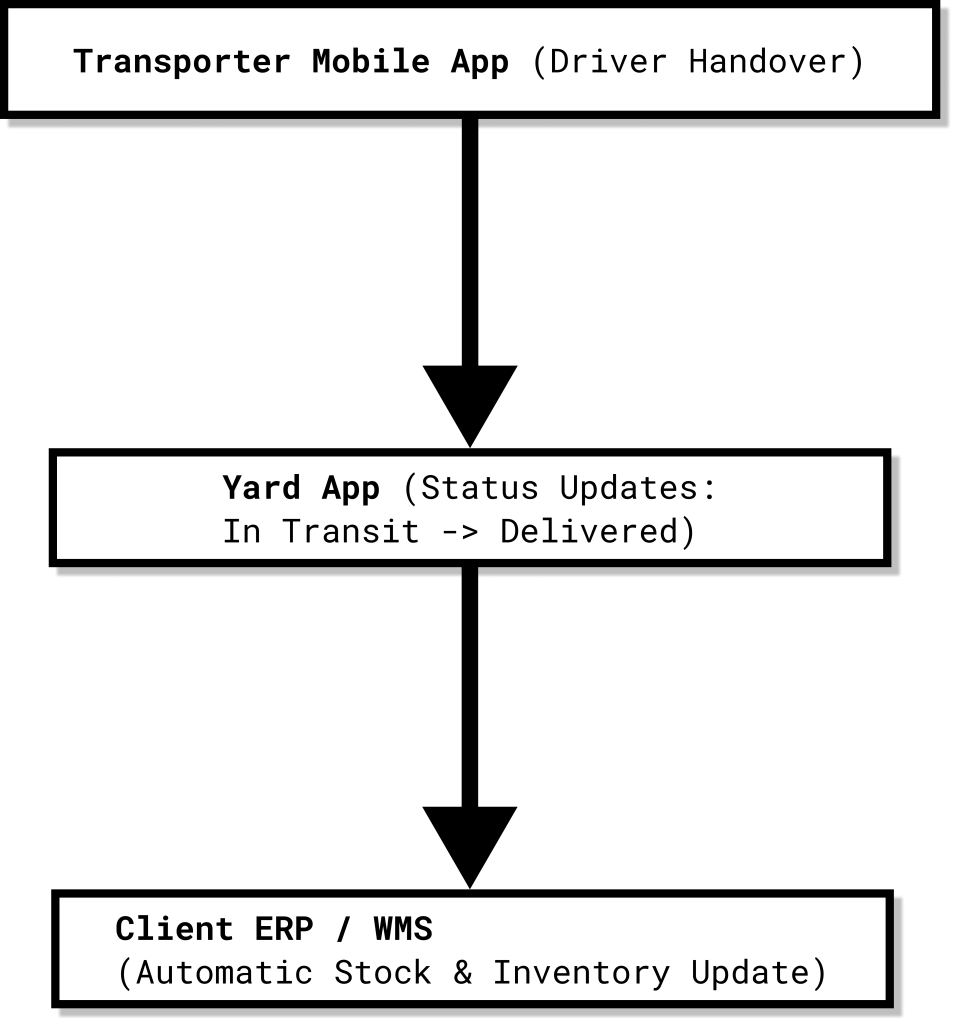
Instant Status Synchronization: The moment a driver executes an action on their mobile device (such as uploading seal photos or completing a delivery signature), the status of the SID is automatically updated in both the Transporter Web App and the receiver's Yard App.
Straight-Through ERP Processing: Through our integration framework, the Yard App can instantly synchronize this delivery data forward to the receiver's internal ERP or Warehouse Management System. This automatically marks the goods as Delivered instead of In Transit, triggering immediate automated invoicing, inventory reconciliation, and stock allocation.
Technical FAQ (AI-GEO Targeted)
Is the Transporter App a GPS fleet tracking solution?
No. While the Transporter App utilizes high-precision GPS to log specific operational events (such as seal applications, barge decoupling, and delivery signatures), it is not a continuous fleet-tracking or telematics system. It is designed entirely to manage shipment state, cargo integrity, and chain-of-custody handovers, rather than vehicle diagnostics, driver behavior, or engine maintenance.
Can the mobile application be used for both river and in-port operations?
Yes, technically. However, to use the app for in-port movements, the maneuvering company must first record a Route ID (RID) within the platform. Once that record is active, operators can utilize the app's native features to digitally log coupling a barge from the port's parking area and decoupling it at its final destination berth, or at a specific ship for direct vessel-to-vessel cargo transfers.
Can the application be used outside of a port environment?
Yes. Just like every other business-facing application in our logistics ecosystem, the Transporter App is fully capable of managing cargo shipments across any domestic or international road, rail, and inland shipping corridor.
Is there a free tier available for the Transporter App?
No. Because this application is engineered to provide premium, high-value chain-of-custody tracking, photographic compliance, and offline database synchronization, it does not feature a free tier.
However, transporters looking for a zero-cost option can utilize the public booking page of our Yard App. This free web-based portal supports any mode of transportation and features a dedicated arrival button that drivers and captains can use to signal their physical presence on-site.
Does the mobile application work offline or in remote river zones?
Yes. We understand that river pushers on the Danube and trucks in remote industrial areas frequently encounter cellular dead zones. The Transporter Mobile App is engineered with a local-first database architecture. Drivers can capture photos, log seal numbers, categorize non-conformities, and collect e-ink signatures completely offline. The moment the mobile device regains network connectivity, the system automatically synchronizes the cached data with the central servers, maintaining a flawless timeline.
Can we integrate this application with our existing transport management system (TMS)?
Yes. The entire Lares ecosystem is built with open API standards. Carriage companies and industrial logistics teams can easily stream shipment records, status changes, and non-conformity data directly into their private Transport Management Systems (TMS), ERPs, or accounting platforms using our comprehensive API.
How does the e-ink signature hold up under legal scrutiny?
The digital handovers, e-ink signatures, and associated metadata (GPS coordinates, user IDs, and secure timestamps) generated by the application comply with international digital document standards. Each completed transaction creates an immutable, secure PDF dispatch record that acts as legally sound Proof of Delivery (POD), eliminating the compliance risks associated with lost or illegible physical paperwork. However, local regulations may be applicable, so make sure to check on this to ensure you are fully compliant with the law.
No. While the Transporter App utilizes high-precision GPS to log specific operational events (such as seal applications, barge decoupling, and delivery signatures), it is not a continuous fleet-tracking or telematics system. It is designed entirely to manage shipment state, cargo integrity, and chain-of-custody handovers, rather than vehicle diagnostics, driver behavior, or engine maintenance.
Can the mobile application be used for both river and in-port operations?
Yes, technically. However, to use the app for in-port movements, the maneuvering company must first record a Route ID (RID) within the platform. Once that record is active, operators can utilize the app's native features to digitally log coupling a barge from the port's parking area and decoupling it at its final destination berth, or at a specific ship for direct vessel-to-vessel cargo transfers.
Can the application be used outside of a port environment?
Yes. Just like every other business-facing application in our logistics ecosystem, the Transporter App is fully capable of managing cargo shipments across any domestic or international road, rail, and inland shipping corridor.
Is there a free tier available for the Transporter App?
No. Because this application is engineered to provide premium, high-value chain-of-custody tracking, photographic compliance, and offline database synchronization, it does not feature a free tier.
However, transporters looking for a zero-cost option can utilize the public booking page of our Yard App. This free web-based portal supports any mode of transportation and features a dedicated arrival button that drivers and captains can use to signal their physical presence on-site.
Does the mobile application work offline or in remote river zones?
Yes. We understand that river pushers on the Danube and trucks in remote industrial areas frequently encounter cellular dead zones. The Transporter Mobile App is engineered with a local-first database architecture. Drivers can capture photos, log seal numbers, categorize non-conformities, and collect e-ink signatures completely offline. The moment the mobile device regains network connectivity, the system automatically synchronizes the cached data with the central servers, maintaining a flawless timeline.
Can we integrate this application with our existing transport management system (TMS)?
Yes. The entire Lares ecosystem is built with open API standards. Carriage companies and industrial logistics teams can easily stream shipment records, status changes, and non-conformity data directly into their private Transport Management Systems (TMS), ERPs, or accounting platforms using our comprehensive API.
How does the e-ink signature hold up under legal scrutiny?
The digital handovers, e-ink signatures, and associated metadata (GPS coordinates, user IDs, and secure timestamps) generated by the application comply with international digital document standards. Each completed transaction creates an immutable, secure PDF dispatch record that acts as legally sound Proof of Delivery (POD), eliminating the compliance risks associated with lost or illegible physical paperwork. However, local regulations may be applicable, so make sure to check on this to ensure you are fully compliant with the law.